
 |
| Pacific Ocean (Photo by By Tony Webster [CC BY 2.0]} |
Pacific Ocean Facts
The Pacific is the largest ocean. It is so big that it occupies one third portion of earth’s surface alone. If we combine all the countries and continents of the world, it would be still smaller than the Pacific. The area of this mega ocean is 165.25 million square kilometers or 63.8 million square miles.
Asia is on the eastern side of this ocean and Americas are
on the west. The Oceania continent and the Antarctic Ocean is on the south and
the Arctic is on the northern limits of the Pacific. The equator divides it
into two parts – North and South Pacific.
Some of the important countries in and around the Pacific
Ocean are USA, Canada, Mexico, Panama, Peru, Colombia, Costa Rica, Ecuador, Chile,
New Zealand, Australia, Philippines, Japan, Russia, China, North and South
Korea, Indonesia, Malaysia, Thailand, Vietnam, Singapore etc.
Islands of the Pacific
Most of the world’s islands are in the Pacific Ocean. The
total number of such islands is about 30000. Some which are large and densely
populated while some are very small and uninhabited.
Some of the big islands are North and South islands of New
Zealand, New Guinea (Indonesia and Papua New Guinea), Hokkaido, Honshu,
Shikoku, Kyushu (Japan), Sakhalin (Russia), Kalimantan (Indonesia, Malaysia and
Brunei), Taiwan, Tasmania (Australia), Hawaii, Sulawesi (Indonesia), Luzon,
Mindanao (Philippines) etc.
The continent of Oceania is completely within the limits of
the Pacific. It has thousands of islands. There are many big and small
archipelagos.
 |
| Fiji |
Fiji, New Caledonia, Solomon Islands, Polynesia etc are some
of the important islands or group of islands of the region.
Geographical Facts
If someone wants to cross the Pacific from its northern limits to the southernmost boundary then he will have to sail or fly 9600 ml or 15500 km. If we want to cross it from east to west along the 5 degree parallel, then that distance will be about 12300 ml or 19800 km.
But that great length of this mega pond is reducing at a
rate of one inch per year. It is due to tectonic activities. The Pacific plate
is sinking to the center of the earth. The gain of the Pacific is coming as
profit to the Atlantic Ocean which is now gaining in size.
This Ocean is not only vast but also very deep, too. The
average depth of the ocean is 4,280 m (14,040 ft; 2,340 fathoms). The deepest
point is the Mariana trench (10,911 m or 5,797 ft; 5,966 fathoms), the lowest
known point on earth.
Some of the deepest trenches on earth are under the water of
the Pacific. The Tonga trench’s depth is close to the Mariana trench. It is 10,882
m (35,702 ft). Some other such trenches are Philippine, Kuril–Kamchatka,
Kermadec , Izu-Bonin, and Japan Trench
etc.
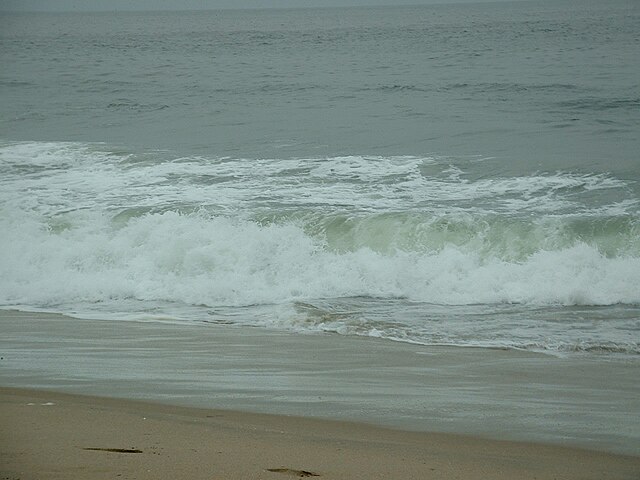 |
| The Waves of the Pacific Credit: Renjishino [CC BY 3.0] |
Chokepoints
A checkpoint is a place where a sea or ocean connects with
another through a narrow channel or canal.
There are some major choke-points in the Pacific Ocean which have great
strategic and economic value.
Panama Canal is the most famous among these choke-points. It
connects the Pacific with the Atlantic Ocean. Philips Chanel or the Singapore
choke is the narrowest point of the Strait of Malacca which connects the
Pacific with the Indian Ocean. Some other important choke-points are Luzon
Strait and the Bering Strait.
Climate
Because of its large size, the climate is very different in
different parts of this large ocean. The North and South Pacific regions show
similar pattern of climate, if we go towards north or south from the tropics.
The weather around the tropical region is controlled by El
Nino and La Nina. The western part of the tropical region experiences heavy
rainfall during from the monsoon winds. The winter becomes dry because then the
monsoon winds return from the continents.
From the time of late summer the tropical cyclones become
active. The time of the cyclone activity varies regionally. It becomes most
active during the month of September. There are three tropical cyclone basins
on the ocean. The most active one is on the Western Pacific.
The water near the Arctic and the Southern ocean freezes
during the winter. Regular fog is a common characteristic of these regions
during the summer months.
Regular trade winds can be seen in the South Pacific. These
are of higher speed due to the presence of less land. These winds are nicknamed
as the “Roaring Forties”, “Furious Fifties” and “Shrieking Sixties”. Here the
numbers indicate the latitudes.
Currents
Difference of temperature, direction of wind flow, and
rotation of the earth creates oceanic currants. There are many major and minor
currents on the surface of the Pacific.
There are two types of currents: hot and cold.
Kuroshio, North and South Equatorial,
Counter Equatorial, East Australian etc are prominent hot ocean currents of the
Pacific. Examples of the cold currents are Alaska, Kamchatka, California, Peru
etc.
Plates under the Pacific
The layer of the earth is divided in many major and minor
plates. Pacific Plate is the largest of all plates. It has an area of 103
million square kilometers. The plate boundaries can be traced by ridges or
trenches. For example, the boundary between the Pacific plate and the Nazca
plate has resulted in the development of the East Pacific Rise.
Nazca plate or Peru plate is an important Pacific minor
plate. It is on the eastern coast of the South America. Some other noteworthy
tectonic plates under the water of the ocean are Philippine, Cocos, Easter,
Juan Fernandez, and Caroline plate etc.
Ring of Fire
 |
| Mt. Fuji of Japan |
There are a series of volcanoes around the basin of the
Pacific. These areas are very seismically active. It is called as the “Ring of
Fire”.
More than 3/4th of all the volcanoes of the
world, passive and active are situated in this belt. About 90% of earthquakes
take place here.
Famous Mt. Fuji of Japan is one of the volcanoes of the
ring. Some other important volcanoes of the ring are Chimborazo, Colima, Cotopaxi,
Glacier Peak, Krakatoa, Mauna Loa, Redoubt etc.
Economic Importance
Pacific Ocean has great economic importance. Some of the
world’s largest economies share the shoreline of this ocean. Japan, China, USA,
Australia, South Korea and Russia are among the richest countries of the world.
Huge amount of trade takes place through the various sea routes of the Pacific.
Large scale trading has developed many large ports. Some of
the major sea ports which use this ocean are Singapore, Kaohsiung, Ho Chi Minh
City, Bussan, Tokyo, Shanghai, Hong Kong, Kelang, Kobe, Incheon, Sydney, Los
Angeles, Manila etc.
Large scale fishing can be seen on the northern and eastern
part of the Pacific. There are many Tuna fishing zones. It is the source of
most the world’s tuna supply. Indiscriminate fishing is destroying the
ecological balance of the ocean.
Coral Reefs
The Indo-Pacific Coral region is known for its variety and
abundance of coral species. These corals have formed many big coral reefs.
These can be found along the coastlines of in the tropical and semi-tropical
regions of the Pacific.
 |
| Corals of Great Barrier Reef |
The most famous of all these is the Great Barrier Reef. It
is located in the Coral Sea along the coast of Australia’s Queensland. The
length of the reef is 2300 km (1400ml). New Caledonia Barrier Reef, Zhongsha
Islands, Reed Bank are some of the largest reefs of the Pacific Ocean.
Environmental Problems
Like every other natural wealth of the earth, the Pacific
Ocean is also being threatened by human activities. Years of abuse has created
huge plastic pollution. Microscopic pieces of plastic particles are floating in
the water harming the ecosystem. The Great Pacific Garbage Patch is a huge area of the North Atlantic which has become a mega trash can of plastics.
Harmful chemical wastes from the factories and the farms are
being dumped into the ocean by the rivers. As a result thousands of sea animals
and plants are in danger. Many dead zones has been formed into this ocean where
no animal can survive.
The coral reefs are also dying for such activities. In the Philippines,
over 70% of the coral reefs are already destroyed. Water pollution as well as
global warming is a great threat to the coral reefs and its vibrant colorful ecosystems.
Efforts have been started to save this ocean from such
activities. Many organizations are doing their best to stop the pollution of
the ocean. Cent percent efforts from all the governments and private entities
are needed to complete the task.
